I found this documentary on Cindy Sherman a must watch because Her work is so captivating and intriguing. It was interesting to see Cindy talking about her work and how her experiences have influenced her photographs, such as how when she first moved to New York in the 1970s she felt isolated as people weren't as nice as she hoped, which is cleverly shown in her images. In every single photograph of Cindy Sherman I see a story, which is what she says she wanted from her audience 'to create a story' and to 'stir a lot of memories' and that is exactly what happens when I look at these images. I automatically feel like know what the character is and what they do because of the clothes and make up Cindy puts on, that is clearly Inspired by media and societies.
Wednesday, 22 January 2014
'Nobody's Here But Me'
I found this documentary on Cindy Sherman a must watch because Her work is so captivating and intriguing. It was interesting to see Cindy talking about her work and how her experiences have influenced her photographs, such as how when she first moved to New York in the 1970s she felt isolated as people weren't as nice as she hoped, which is cleverly shown in her images. In every single photograph of Cindy Sherman I see a story, which is what she says she wanted from her audience 'to create a story' and to 'stir a lot of memories' and that is exactly what happens when I look at these images. I automatically feel like know what the character is and what they do because of the clothes and make up Cindy puts on, that is clearly Inspired by media and societies.

Mark Power
Mark Power
http://www.markpower.co.uk/
http://www.markpower.co.uk/
I have decided to take a look at Mark Power's work because after admiring some of it for Street Photography, I thought it would link in with this module. I have found some of his projects very hard hitting and quite cold in a way because in context they are reality. I think that Power is really successful in showing the clear intention in his photographs whatever his project is, but the ones I have chosen to present below, are the ones I feel are the most accurate towards Photography and Narrative.
The Childrens Society

This collection of images was the first of Mark Powers I looked through. This was his first commissioned job in 1985-1986 and was for The Children's society, to present what it was it was like growing up in certain areas of Britain such as the North and the Midlands. When I look at these images, they all have the same sadness to them and make me feel quite poignant because they are all real life people in real life situations, no models or retouching was used in the making of these photographs and the fact that the project was based on children is also very sympathising, but the whole point of the images was to show their vulnerability and how awful these children's lives were. I feel each photograph presents a story that you can see within the image by the surroundings and the expression on the children that are included in the photographs that overall is the evidence of poverty and I expect made the audience feel very sympathetic, as people would today because it is still relevant to how some children are living.
Buren

Buren was a project that documented life in the Netherlands. I thought that this was an interesting comparison to 'The Childrens Society' because the images are quite contemporary but at the same time still show a story of different details of the way of life and history in parts of the Netherlands, similar to the situation in the above project. I like the way Mark Power has included paintings and sculptures because it shows how even art that is not his own, is important and factual to his own photographs because they also present a development in history. The reason I have chosen to include 'Buren' is because as I have been researching Power's work, all of his images seem to document a story and have a purpose and intention, which I admire because they are evidently successful in showing the Netherlands in 1999-2000 in his own images but then are compared to the other art forms that he included.
26 Different Endings

The last project I have decided to analyse '26 Different Endings' of Mark Powers, was focused on the tourist book 'A-Z London street atlas' and how it changed with each new edition which is published and these photographs are the areas which were not included that '...fall just off the edge.' which Power captured during 2003-2006. Personally, I feel a sense of isolation within these photographs that could represent London as in such a gritty, large city people tend to feel quite alone and because it seems like Mark Power is presenting the more hidden parts that are not normally seen or given any attention, people who live in London may experience this emotion as it is quite a hard faced place.
Overall I have found Mark Powers work very captivating and I have immediately became absorbed when looking at his photographs in his projects. He is very successful at presenting a story and as a collection of images together in each of his projects they make them complete in the story they show very powerfully.
Sunday, 19 January 2014
Tom Hunter
Tom Hunter
http://www.tomhunter.org/gallery/
Tom Hunter's unique work has been exhibited internationally and is shown in galleries all over the world. He has published numerous photo books during his careers and won diverse awards. After looking through his website and reading some of Tom's blog posts and projects, I found his images very interesting. His work is very captivating because in every one of his images he has created a story that really shows through, which seems very compelling and dynamic to its audience and somehow always shows influence of his home town, which makes it look like a important part of his life, shown through his images. Below are three of his projects that I have chosen to analyse.
UNHERALDED STORIES:
Tom Hunters collection of work 'Unheralded Stories' shows a sequence of images that are influenced by politics. After taking a look through the ten photographs shown in this collection, I sort of understood what politics had to do with the images. I decided to present the below image 'Death of Coltelli' because I felt this one really shouted to be a story that has influence to do with the projects major theme as I think the woman leaning on the bed makes this photograph powerful. "Politics are expressed through actions, hopes and desires" - Without her as the main subject, the story would not be as clear, making me question her life and what it has to do with politics and how they have affected her, which it seems it is not in a good way and that they maybe control her.

'Persons Unknown' show Tom Hunters work of his subjects in their everyday life, caught by his camera in what seem like moments that have been frozen in time. In this series, most of the images are captured near a window and are either of one person or two. I find this quite clever in what Hunter might be trying to put across, which maybe the isolation of the subject in their everyday lives that they look to be very alone within the photograph. The image I have chosen below "Woman Reading a possession order" shows the above content well in my opinion as I feel the letter she is reading has an importance and has a connection to the light shining on her from the window or the expression on her face because of what the letter says, really creates the main factor of what I think is isolation that makes you believe there is a story within.
an Reading a Possession Order

TRAVELLERS:
The final collection of images of Tom Hunters gallery that I have decided to analyse is 'Travellers'. I found this of real interest because after looking through these images and reading the information about it, I really enjoy the fact that he captured the experiences of his own and the people he met whilst travelling around Europe over a two year period. It made it really captivating while I was looking through the photographs because they all had a narrative feel about them because it made me think about his subjects lives and what there experiences were also by looking at where they maybe slept and what possessions were in the image, that defined the image to who they were and what they were doing. I feel that this really shows in the untitled image below, whether the subject is in his own home or not, his posture makes him look comfortable as if he lives there, as well as the possessions that are surrounding him which makes me think of a story about his life and how he grew up and why he owns the objects that are in the photograph.

Overall I found that Tom Hunters work really did represent 'Photography and Narrative' because his work seems to represent the lives of people he meets or the projects he creates to show a story to his audience by the expression and emotion in each of his images that has made me want to know more and I'm sure others also, which is what I think is an important factor in presenting a Narrative, making us look deeper in to the photograph.
Saturday, 18 January 2014
Photography and Narrative
Narrative: A story or accounts of events, experiences, or the like, whether true or fictitious.
My initial thoughts for the new assignment 'Photography and Narrative' is that it could be quite intriguing. The idea that I can capture a story that I can create, within a photograph really excites me because I can engage whatever I want and it can be anything I want in the image. I have already thought of a few ideas that I would like to experiment with in part one of the assignment, as it only requires one final photograph that I would really like to concentrate on at the moment. My inceptive ideas that I think could be successful is the concept of family because I find that with different relatives, you get different stories and experiences depending on how interesting they are. I hope that in this assignment I can create something that will captivate my audience and develop it in to something powerful.
Wednesday, 15 January 2014
Evaluation
Evaluation – Introduction to the studio.
Throughout the unit, the idea of what a portrait is has
always cropped into my mind, whether it was when I was researching on my blog,
or in the studio shooting. Only until when looking at the photographs that I
have chosen as my final ones, it has occurred to me that an unintentional theme
has appeared throughout my images. I think that this has been easily done
because of the fact I have never been in a studio environment until starting
this unit and having it being called an ‘introduction’ so more simple portraits
was going to be the option I would take. The theme or style that I think I
wanted to show was the connection between my subject and the camera. The three
photographs I have chosen, all show this through the expression on my subjects
face, which I wanted to be clear throughout, creating a mood within the image that
would make it interesting to look at to its audience, which I think I have
achieved. I think I made this successful because of my direction to the subjects
by asking them to change their expression every now and again whilst looking
straight in to the camera. I think this was important because I did not want
the same appearance in all of my photographs. The whole Unit I have found that it
has been full of new techniques and experiences that I have thoroughly enjoyed because
of it being different. The use of the studio lighting for the first time was an
interesting one because as I have never worked in one before, it was an
enjoyable challenge using all the studio lighting and learning how to use it,
but also using a Hasselblad camera which was also very new to me that I found
the most challenging of all because of how different it was to using any other
camera that I have before. The use of a photo lab over the internet was also a
new experience, that was a part of the brief for my final photographs, to be
printed at a professional photo lab, after the use of capture one to edit my images.
Overall I think I have achieved the requirements of this module by producing three
photographs that appear to be studio portraits by using the equipment and
research required. I think this because I feel that I have developed my skills
by working in a completely new photographic environment and creating a type of
work that I have not done before. If I was to do anything differently, it would
to do more shoots to broaden my work and knowledge further creating more option
when choosing my final photographs. I also would go back and think about what I
wanted my subjects to do a bit more such as what they were wearing and how they
looked to make the feeling of what the story in the photographs a lot stronger.
However I would conclude that my work has been successful and I would love to carry
on doing studio portraits.


Steve McCurry x2
As I have just came across this video about Steve McCurry, I thought it would be important to post it because as fascinating as I find his work, I think it is relevant to this unit although it is based on portraits in the studio and his work is generally always outside.
Studio Lighting
http://petapixel.com/2011/11/12/five-basic-lighting-techniques-for-studio-portraiture/
I found the above link which includes different types of lighting very helpful when I had just started in the studio. It gives a quick overview of studio lighting and how different types, compliment the model in a different way and gives a different appearance. It was helpful because I found all the lighting and different plugs really challenging as I had never worked in a studio setting before or set the lights up. After being showed what to do and trying it out for myself, I found that it wasn't as difficult as it looked or as I thought it would be, although it did take me a few attempts to get used to it.
I found the above link which includes different types of lighting very helpful when I had just started in the studio. It gives a quick overview of studio lighting and how different types, compliment the model in a different way and gives a different appearance. It was helpful because I found all the lighting and different plugs really challenging as I had never worked in a studio setting before or set the lights up. After being showed what to do and trying it out for myself, I found that it wasn't as difficult as it looked or as I thought it would be, although it did take me a few attempts to get used to it.
Steve McCurry


Steve McCurry
Steve McCurry's work has been recognised for over 30 years. His images such as "The afghan girl" is one of the most noted and powerful photographs in the world. He has travelled all over world to capture his stunning images, mostly in Asia. McCurry's portrait style is actually really beautiful when analysing them, the colour is vibrant and you can really feel the presence of his subject.
"What is important to my work is the individual picture. I photograph stories on assignment, and of course they have to put together coherently. But what matters most is that each picture stands on its own, with its own place and feeling."

Rankin Live
As I was going through the 'Rankin Live' channel on youtube, I found it really interesting to see how one of the most famous photographers in the world works and what the people he was working with thought also. I have chose to include the video above because one of the people Rankin was shooting said that you don't have to be beautiful to be in a photograph but just interesting. I really believe what she said because it is what makes the photograph captivating and beautiful as an image over all, rather than what the person actually looks like.
Progress
Looking over my photographs from the shoots in the studio, I do not believe that I have had a certain theme in mind when taking the images. However I think that I have developed a style in my photographs which is clear when looking at my photographs all together. I find them all to be quite simple in how they appear, but have the obvious essence of a portrait that carry a certain emotion, which is what I feel makes it interesting to think about what the subject in the portrait is feeling or thinking. This reason is what I wanted to put across in my images because when I look at other peoples work I want it to be captivating so that it makes me think, which is what I hope is put across to an audience looking at my own work. Overall I will have this in mind when I choose my final images for the module, hoping to decide on the photographs that appear to be the most fascinating.
Shoot 3


Here are some of the photographs I had taken in my third shoot. I think that by this point I understood the Hasselblad a lot more than previous times taking photos. I really like the style that is apparent in these images, the focus is a lot clearer and the emotion shown on my subjects faces is more understanding, in that I think they are more interesting to look at and understand. The positioning in these images is also more successful as I have gotten more used to the camera, shown how they are more in the centre. I think I have acknowledged the term 'portrait' more clearly in this selection of images because of their positioning and expression.


Understanding the Hasselblad
As I have never used a Hasselblad camera before starting this module, I found the first time using it very challenging. It was strange using a camera that I had to look down into the viewfinder and quite stressful at times when I could not focus or position it right so that my subject was in line and in the middle of my image. The particular camera we have had to use has a phase one digital back so we are able to see it in the programme capture one, straight away from taking the photograph. After I had got the swing of things, I found the Hasselblad really fun but still challenging to use. Every shoot, I learned knew things about the camera and how I could improve my photographs. I also loved the look of the image, which I think is perfect for portraits because it gives a really simple and clean appearance.

Tuesday, 14 January 2014
Shoot 2


Here are some of the photographs from my second shoot. Compared to my first shoot, it is clear that I have gotten used to the camera a lot better. The more photographs I had taken, the more they were improving such as the focus of the camera, which is shown through the programme capture one, that shows if the image is in focus or not. I like the lighting a lot better in this shoot than the last one because the images are more clear and can see my subjects face and expression.
Past Portraits


Here are a few photographs of my brother I took a couple of months ago which I thought would fit nicely with my portrait research. I think that these images resemble portraits quite clearly because they are showing a certain amount of my subject and the emotion on his face. Also I think it shows how portraits are evident without the need for being in a studio.
Shoot 1


Here are some of the photographs that I had taken during my first shoot and first time using a Hasselblad camera and being in a studio environment. I quite like the lighting technique I used over all, considering I was experimenting with the equipment. Overall I think my photographs turned out quite successful as a first attempt.


Cindy Sherman
Cindy Sherman


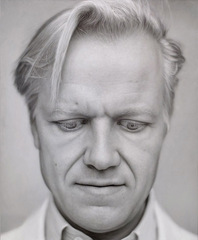
As one of my favourite photographs, I thought it was only right to include Cindy Sherman in my research. Cindy Sherman is now one of the most successful and popular photographs of our generation, her work only ever includes self-portraits of herself which prove to be very interesting and intriguing in all of her projects. The images I have included are only a minor few of her large archive, but I find them all equal in showing how diverse her work is. In each of the images, they all show Sherman dressed as different women appearing to be in very different situations and societies. They all seem to tell s different story, which is what I think is great about her work as it is so interesting to analyse her photographs and try to work out what is going on in them and the individuals she is playing from the emotion on her face and area of where the photograph was taken.


http://pilarrossiblog.wordpress.com/2012/03/24/cindy-sherman-at-moma-the-queen-of-the-self-portrait/
http://www.moma.org/interactives/exhibitions/2012/cindysherman/#/3/
http://www.moma.org/interactives/exhibitions/2012/cindysherman/#/3/
Andy Warhol
Andy Warhol


Andy Warhol was one of the most well known artists in the world. Even after his death, Warhol's work has carried on to be even more popular. Throughout his work it is evident that he concentrated more on portraits. His photography work began in the 1960's and apparently carried a camera with him at all times and documented his life through his photographs. The 3 photographs I have presented are of Bob Colacello, himself and Bianca Jagger. I feel that they indicate portraits very well as they are simply showing a head shot of the individuals in a passport photography style but have a bit more personality about them making them seem more interesting, such as the expressions each of them have in the images, making me think why did Warhol want them to pose like that, including the self-portrait of himself. I think it is quite peculiar how Andy Warhol has dressed in the photograph of himself because as quite an obvious controversial man, I can imagine it caused some questions during the 1970's when it was shot. Warhol is clearly successful with his portraits in all of his art forms, including his work during the pop art era, when he was most popular. I have included one of his most famous pieces below of Marilyn Monroe, which today is very beloved to this day.

http://lightbox.time.com/2013/09/09/andys-world-rare-photographs-from-warhols-own-camera/#9
Subscribe to:
Posts (Atom)